CrEW for Educators: “Holding the Space for Big Feeling” in these Tumultuous Times
Categories: School Crisis Recovery, School Crisis Renewal, Storytelling, Workplace

SCRR Introduction
Student trauma and grief healing require a firm paradigm shift to include educator wellness as equally vital to student wellness. One cannot happen without the other: symbiotic in relationship, educator wellness impacts student wellness and student wellness impacts educator wellness.
At SCRR, we firmly believe and know that mending our wounds is not an additional or extra move to the work: educator and school leader recovery and renewal is necessary and hard, and necessarily hard. Most vitally, educator wellness can come most alive– or re-aliven– in the community. Self-care and collective care. Self-preservation and collective preservation.
Here, Stephanie Cariaga and Melissa Merin share the vision, story, and learnings of CrEW, “Critical Embodied Wellness (CrEW) for Educators.” First, Stephanie Cariaga offers the origin story of CrEW and its ambitious, yet necessary objectives. Next, Melissa Merin offers a closer look at some experiences in CrEW’s in-person cohort, where she and others collectively learned to be in, feel, and teach through radical embodiment.
An introduction to CrEW – Stephanie
Some things seem too big to be felt alone because they are. They require the collective to hold the space for big feeling, for it to move through, and to remind us that we’re not alone.
Prentis Hemphill, from What it Takes to Heal: How Transforming Ourselves Can Change the World (2024)
As I write this, many educators I know are feeling big anticipation as they start another academic year, carefully curating their classrooms with beautiful artwork, systematized routines, and community-building activities.
For justice-centered educators critical of schooling and other systems of oppression, this anticipation can also come with big dread.
Many of us tried to restore ourselves during the summer but we still feel deeply depleted – from simultaneously resisting and being complicit in genocide, witnessing (and for some of us experiencing) the ongoing impacts of police brutality and climate disaster, being in the midst of a contentious election season, and still grappling with collectively unprocessed trauma and grief from the pandemic and its impact on our nervous systems and learning spaces.
Perhaps the big dread comes from sensing, like Prentis Hemphill says above, that all of it is too big to feel and navigate alone.
In my two decades as an educator, first as an English teacher and now as a professor in teacher education, I am familiar with the full range of emotions that come with teaching. I am also familiar with the ways that schools and the academy are not safe places to feel, particularly for those of us at intersecting margins of society. Even though social-emotional learning (SEL) has become a mainstream practice in schools, such SEL practices can be superficial and even harmful if we are unable to reconcile with our society’s underlying beliefs and policies about who gets to feel and who doesn’t. Too often, schools police the emotionality of Black and Brown, femme, queer and trans, working class and dissenting bodies, while allowing the dominant feelings of white, cis-gender, masculine, heteronormative, and wealthy voices to be heard and even weaponized against others.
As educators, we often internalize capitalist, patriarchal, white supremacist notions about feeling: we apologize when tears fall from our eyes; we push past feelings of fatigue and depletion; we get uncomfortable and avoidant when there are big feelings in the room. To teach and model healthy emotional intelligence, especially at a time when we are up against so much collectively, we must learn to embrace and learn from our feelings, instead of pushing them away or onto others.
This is why I created a collective learning space called CrEW, which stands for Critical Embodied Wellness for Educators (CrEW).
In Fall 2023, I, in coordination with a southern California university for extension unit credit, initiated two inaugural cohorts of CrEW, where 45 educators spent a six-month journey re-learning the language of their bodies and practicing wellness strategies to better care for themselves, students, and school communities. To provide a variety of accessible and engaging learning experiences, we had one virtual cohort (led by Candice Valenzuela and Dominique Cowling) and one In-Person Cohort at a university campus in Southern California (led by myself and Tanya Suzuki). Through a meticulous application process, each CrEW member was selected if they had at least one year of experience in education (broadly defined to include a wide variety of educators, like teachers, administrators, restorative justice coordinators, professors, social workers, and more), as well as a clear interest in cultivating justice, care, and wellness in education.
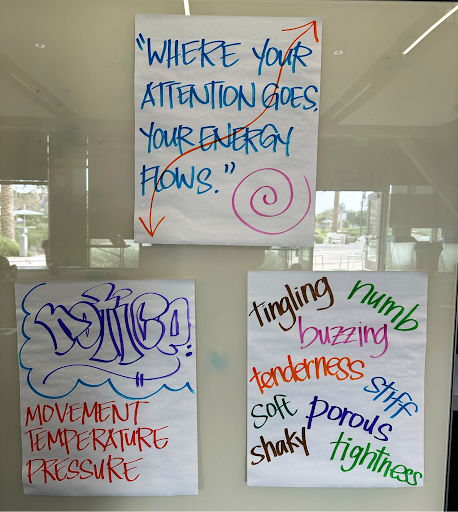
A few anchor posters made by Tanya Suzuki for the in-person cohort of CrEW to practice feeling through the body.
In these CrEW cohorts, we focused on Critical Embodied Wellness for several reasons:
- We started from the understanding that schools and the academy are founded in and reproduce systems of punishment, suppression, and inequity; therefore, all of our learning and wellness practices in CrEW sought to critique, disrupt, and resist the violence of schooling.
- We prioritized learning through and from the body because of the ways that schooling conditions us to be estranged from our bodies and those we care for. We got back in touch with our intuition, sensations, and other embodied communication that helps us reconnect to our desires and purpose as educators, enhance our capacities to care for ourselves and our respective communities, and fight towards a freer world. We drew from Black and Brown feminists like Audre Lorde and Leny Strobel, as well as trauma-informed and somatic practitioners like Staci Haines and Prentis Hemphill, who assert that the body is a powerful site of wisdom and transformation.
- Through a healing justice lens, which we learned through the teachings and movement work of Cara Page and Erica Woodland, we didn’t practice wellness just to care for ourselves. We practiced wellness as a way to reclaim embodied and ancestral ways of knowing, to begin to rectify the harms of schooling, and to practice freedom together.
With more than 50% of educators considering leaving their jobs and more than 60% of Black and Brown educators wanting to leave in the past couple years (Walker, 2022), we know that we are in a crisis as a field and as a society. In collaboration with our first two cohorts, we co-created CrEW as a refuge space to unravel and make meaning from the ongoing, cumulative crises of our times.
The Power of Embodied Practice – Melissa
Like so many of us, I got into education because I wanted to “make a difference.” This is a standard phrase you hear from folks when they start talking about their education journeys, and it means something different for everyone. The difference that I seek to make is to help adults who work with children in any educational context to learn to think differently about who students are and what discipline in schools can look like. I want to help folks connect their relationships to the students they work with to the students they (educators) once were; in other words, I want to help guide the work of seeing students as whole beings with values and abilities to be guided and nurtured.
This mission is as personal as it is political for me. I love learning. I learned to read for comprehension and to write very early. I loved taking multiplication speed tests and learning historical facts that I would later expand upon with encyclopedias at the library. I’m a fan of debate and exploring different perspectives, but oh my gawd, did I hate going to school.
School was a site of trouble for me. As one of very few Black kids in most of my academic settings, I was the first person to be singled out if there was a group of people talking in class, the first to be sent to the principal’s office after any conflict. I learned that my existence equaled punishment from a very young age. I was suspended several times in elementary school alone. Aside from “reading, writing, and ‘rithmetic,” I also learned how to mask my feelings, to hold my breath, and to mimic white kids in class. Luckily, there were a handful of very talented educators who kept me from being a statistic, and because of them, I have been able to carry my critical thinking and empathy skills into my personal and professional lives, and to pay it forward in a sense.
Of course, none of this comes without a price.
I was accepted into CrEW while I was working as a co-director of a TK through 8 charter school, and I was really running myself into the ground. My average day was 10 hours at school and 2-3 hours on the road. My family was not getting the best version of me. My body was in a slow collapse – a tendon strain here, a slipped disc there, some arthritis on the knee… Like most of us, I would grind through whatever, show up early, stay late, bring work home, and do it again the next day.
Public education in the post-pandemic lockdown landscape has been rife with challenges and my school site was no different. We had people out constantly, either because they were sick, or their family members were sick, or they were simply burnt out; some educators at our site quit while still others were fired. Every adult inside of our school was taking on a lot of responsibility in a school model that had shifted because everyone had been out of the physical school setting for up to two years, and everyone was expected to pick up wherever they left off. Despite our best efforts, this made for an uneasy and often demoralizing work environment. As an administrator and a person who dealt with “behavior,” I found that everyone from students to staff was really treading water, with many of us working overtime to keep our students from drowning.
My position and assignment in the school were unique: to help this school move in the direction of applying restorative principles to all areas of educational practice. Sometimes I would find myself at odds with my boss or some coworkers, all in predictable ways, mainly because learning to work with and be with children in ways that are antithetical to how we were raised and taught is hard! There is a lot of unconscious and overt learning that needs to happen. I’ve seen people change their minds, their practices, their relationships with positive results, so I kept pushing.
I made the wrong decision for myself and for my body and my body doesn’t miss a moment to remind me. I was moving through the world and through work as if my body didn’t exist as a part of me – until things got extreme with it.
Many educators that I know feel a profound sense of duty and responsibility and we ignore our bodies over it. We talk about never having to take a sick day or not getting to take a break during the day. There is a cynical valor that comes with running our attentiveness and our care and our reasons for entering education into the ground; the present participle (good educator) clashing with the future perfect (sacrificed body.) Intellectually, I know that this is irrational. I fancy myself an alternative and critical thinker, a member of multiple subcultural groups. I believe that none of us should have to grind ourselves into dust for freedom and for justice, equity and equality. It turns out that this is how I have been operating my entire professional and organizing life.So about once a month, I went down to the southern California university and opened myself up to the work that is CrEW. Each session opened in a circle outdoors. We were assigned texts, videos, and discussions and writing work. We were introduced to different embodiment practices which we were encouraged to do throughout the time of the course. We were placed into separate groups called W.I.G.s (Wellness Inquiry Groups) so that we could have more specific time to share intentionally and/or intimately our thoughts about the different texts or assignments, and about our work and our burgeoning wellness practices.
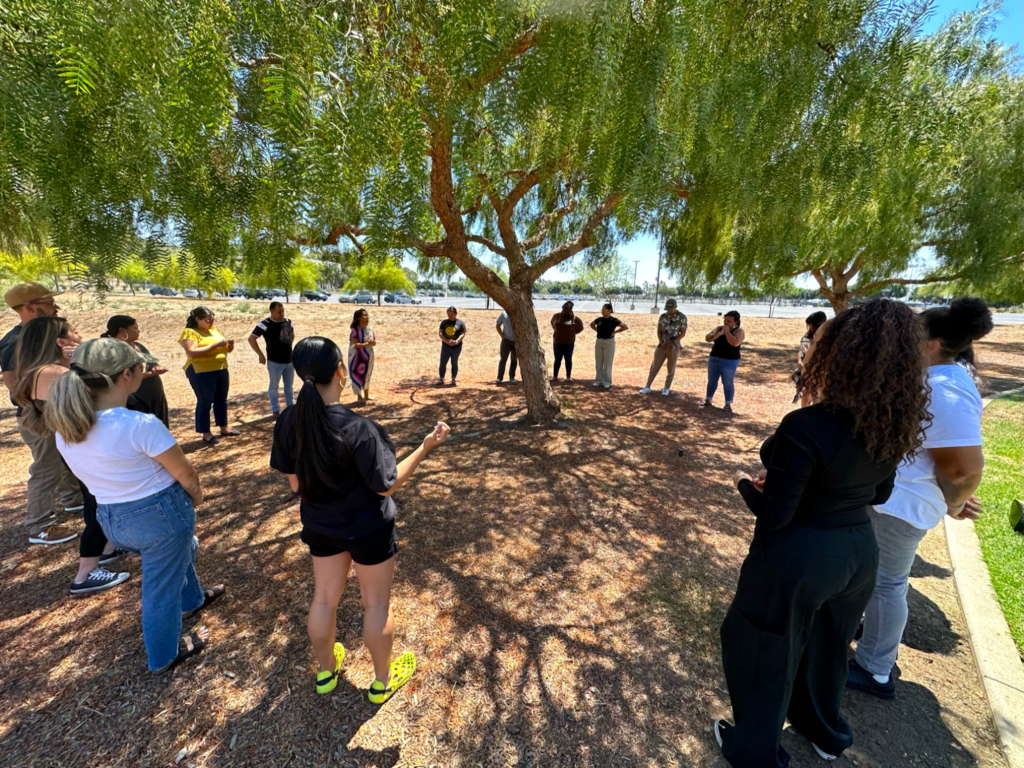
The first in-person cohort of CrEW for Educators engaging in our opening circle for the day.
We were challenged to integrate our embodied practices into our educational lives if possible. I chose body scans as my practice:
- I’d find a quiet place and get into a comfortable position.
- I would first pay attention to my breath and how it felt moving through my body.
- I’d then start to focus on my body, starting with my feet, my legs, my torso…
- Anything that felt uneasy or weird or tense I would try to focus on and see if it would dissipate or lessen on its own.
- I would keep the scan moving upward, through my lower back, my spine, chest, shoulders, again stopping for any tension or weird feeling, moving through my neck, jaw, face, scalp…
- This practice took weeks to get comfortable doing.
As I committed to this practice, my threshold for holding things that weren’t mine and for carrying other people’s water at work diminished substantially. I was being radically honest about where I was and how I was genuinely feeling; I was setting boundaries with coworkers whom I respected and admired, along with my boss. I stopped answering phone calls, texts, and emails after 6:00 PM. I stopped responding to every call as though it was THE most critical emergency to affect school ever in the world. I started to feel my body more, and my body did not feel very well all the time. I have developed some tendonitis and arthritis in my hands, which I had been ignoring and which I could suddenly really feel. CrEW classes were challenging me to be a whole version of myself and not just a composite, which turned out to be a little scary, and a little exciting.
As I made my way through CrEW, I started noticing how I was working at counter purposes to my body. Not only had I been ignoring serious pain in my body, but I was also ignoring the fact that my spirit was diminishing. I was ignoring my body in every state. The spring before joining CrEW, I oversaw an overnight camping trip that happens every year with a cohort of students. On the last night of camp, an unfortunate incident occurred which required a lot of follow-up attention and communication. Months in advance of this trip I had taken the following few days off to have surgery that would alleviate some long-term health issues. However, in the wake of this incident, I felt that I had to show up to work the following Monday (that cynical valor showing up again.) It didn’t help that my boss really pushed for me to come to work. I ended up not having the surgery so that I could help deal with the fallout of this incident.
Weeks into CrEW, I started teaching some of the middle schoolers how to scan their bodies. I had been doing a similar thing with younger kids forever, usually to get them to come back to themselves after they got hurt or something sad or disruptive had happened to them and they could not catch their breath, or, if they seemed to need a little assistance figuring out what they wanted or needed. With the middle schoolers, we started exploring different feelings in the body and what their bodies were communicating to them about consent and boundaries and rest. These handful of kids were really open to trying, even when it felt silly/uncomfortable to them, which was unintentionally paralleling my own experience with CrEW. Bringing an embodied practice to work with me expanded how I was able to work and connect with students, and I think that the students were learning and expanding as well.
In the middle of the semester, we started doing work investigating how we cope, and how we react to major stressors or triggers. The assigned media and text leading up to that session gave me a lot to think about. I was body-scanning at work during stressful interactions and then journaling about the material at home. I really dug in and discovered that even though I present as a “Fighter” (on the Fight, Flight, Freeze, Appease scale,) I’m actually more of an appeaser. Since the members of my W.I.G. weren’t in class, my makeshift group was with two of the co-facilitators. They encouraged me to talk through how I discovered this big area of just coping with what I was discovering was my boss’s unpredictability and gaslighting. As I workshopped it with them, we co-created an Appeasement Meter, investigating the activation points that trigger the appeasement and what it looks like at each point. I felt proud of that work like, damn, look at this! I am sharing! I’m not in control of the entirety of this project! I can feel all of these feelings and I’m not dying! This is great!
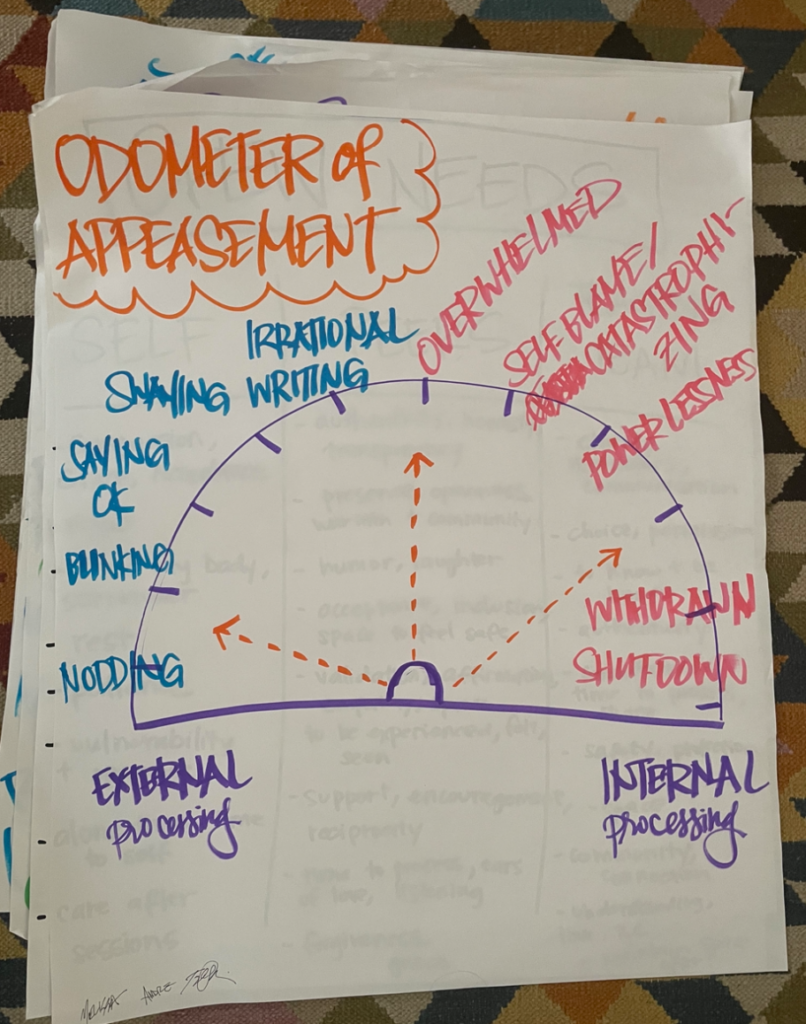
Melissa’s group poster, that focused on a range of sensations and behavior patterns that emerge when practicing the survival strategy of appease.
By the time of our next CrEW meeting, I was not in the greatest of places; I had been surprise-fired two weeks prior. I am 46 years old and have been working since I was 15 and I’ve never been fired before. I have had hard moments with employers because that’s in the nature of working, but I had never been fired. It was shocking, humiliating and endlessly infuriating. It unearthed a lot of uncomfortable feelings for me. Being surprised-fired threw me into a tailspin. Since this particular session was online, I was at home, cozy, and deep in my feelings.
The session began with us doing the embodied practice we each committed to do. I stopped my body-scan halfway through, feeling exhausted and vulnerable. Then, each W.I.G. shared the coping strategy they focused on in our last session. I listened to a handful of presentations and then it was my turn. I felt overwhelmed and asked Andre if he could present our Appeasement Meter. Andre was so sweet and so delicate with the share, and he presented my very personal process of understanding in a way that both anonymized me and honored my experience. As I was listening to him and looking at all of the people in class who chose to be on screen I felt myself turning into a puddle. I let the facilitators and my W.I.G. know that I had to go. I wanted to be present for everybody, but the amount of feeling and overwhelm was too much for the moment.
Being seen and understood through the embodied nature of what I was experiencing was very unique. And I didn’t disappear, and I didn’t die.
I keep feeling – I keep knowing – that it is right for educators to be given space to really encounter their bodies, to encounter everything that comes with and within. Yet, how could we hope to do that if we are constantly disconnected from our bodies? If we’re not able to see the connective tissues between embodied practice and teaching, how can we hope to contribute to working with the “whole child” or “whole student?”
That is the critical piece that CrEW really brings forth. The course teaches us how to be in our bodies, while helping us explore why that is important to our educational practices.
Stephanie & Melissa’s Reflections for Educators, Teacher Educators, and School Leaders
CrEW for Educators is continuing its intention of feeling, being, and teaching through the body as we welcome our second cohorts for Fall 2024. For educators and educational leaders who are interested in reflecting on their own journeys of “holding the space for big feeling,” we offer these reflective questions:
- Self: In what ways do I silence my own feelings? In what ways are my feelings a gift?
- Building capacity to feel: Who can I build with to help process my feelings as an educator in my particular context? How can I recognize and redistribute the emotional labor and taxation of BIPOC, women, and other marginalized and often over-burdened educators?
- Teaching towards emotional intelligence: In what ways do I silence my students’ feelings? How can I honor my students’ feelings in my role as an educator?
- Institutional change: In what ways can we create structures (policies, programs, pedagogies) to disrupt the silencing and punishment of emotions, particularly for our most marginalized students?
About the Authors
Stephanie Cariaga, PhD, has served the wider Los Angeles community for over eighteen years as a high school and middle school literacy teacher, founding member of the People’s Education Movement, and now an associate professor in teacher education at California State University, Dominguez Hills. Rooted in radical feminist epistemology that centers wholeness, healing, and intimacy, her teaching and research examines the intersections between healing justice, critical literacy, and critical teacher sustainability. She is inspired by her best teachers – her kids Laila and Catalino.
Melissa Merin’s work as an educator in San Francisco and the Bay Area spans more than 20 years. Her work centers the radical notions that students deserve to have an impactful say in their education, and that students do not need to be punished in order to learn. For the majority of her career, she has dedicated herself to the practices of restorative and transformative justice, peaceful socialization, and combatting inherent structural and social racism in schools. Melissa currently consults with families, educators and non-profits looking to build a more equitable and just world. She and her partner are the parents of a tenacious and curious 19-year-old, and two joy-bringer dogs.
Want to engage in your own embodied practices? Check out our archived video recordings for educator healing: “Mending our Wounds” – Educator and School Leader Recovery & Renewal → “Movement & Embodiment Practices” & “Self Attuning Practices.”
