Flowers in a Garden: Making space for grief and healing in our schools, in our classrooms, in ourselves – Reflections from a 2023-2024 SCRR Leadership Fellow
Categories: Memorialization & Commemoration, Storytelling, Trauma, Bereavement & Grief, Trauma-Informed & Healing-Centered Schools, Workplace
How do we make space for grief when it shows up in the classroom (for our students, for their families, for our colleagues, for ourselves)?
What practices, rituals, tools, resources, and wisdom of experience can we share with each other to allow for grief–and the process of healing from grief–to be part of our work as educators?
If you are an educator who has taught in the last five years, you likely know intimately that this isn’t a question of whether grief will show up in the classroom or not, but rather a question of how we choose to meet it when it does.
Not if, but when.
Also, not only if and when, but how.
In sharing my grief journey as an educator and what I’ve learned in my healing process, I offer a template to you, fellow educators, to use at your school site. I invite you to take any part of this template, in part or whole, and to make it your own and share it with others.
THE FLOWERS
Through the gift of being one of the inaugural School Crisis Recovery & Renewal Project Leadership I had one year of my life as an educator (2021-22) that nearly destroyed me. I was so raw from the grief and trauma that I experienced that year as a school leader who lost so much–my youngest sister to COVID, my confidence in my ability to lead, and, ultimately, (and by choice) my job–that I had no idea how to even begin the process of making space for myself to grieve and heal. I memorized Ada Limón’s poem “Instructions On Not Giving Up” that year and recited it like a mantra.
I carved out an entire year last year to tend to my heart, to tend to my grief, and I spent a huge chunk of that year in our school garden at Hawk Creek Farm.
This is when I found SCRR.
SEEDS
Through the gift of being one of the inaugural School Crisis Recovery & Renewal Project Leadership Fellows-the learning community of my dreams (both peers and mentors)-I spent last year crafting a workshop that I really needed for myself prior to becoming a school leader. The act of offering the grief workshop to educators allowed me a space to heal that was not available to me when I needed it most.
I wrestled with two ideas at the beginning of my process:
- The idea that even when schools provide trained mental health professionals to support students through grief, students report that they still want to process loss with teachers they trust and who know them already and;
- That educators are often more practiced at holding space for grief for students than they are at creating space for their own grief.
With these two ideas in mind, I crafted a simple structure for my workshop organized as a series of invitations.
PREPARING THE SOIL
After spending time imagining the workshop, I reached out to the Pedagogical Director of my school site to request a conversation about offering the workshop to faculty. Before meeting with her, I did some inner work around imagining what it would mean for me if my offer were met with a “no” and got clear that the workshop was not about bringing an agenda.
She was receptive to my offer and brought it back to school leadership for consideration and conversation. Our College of Teachers said “yes.” Noting that the two previous faculty meetings had been painful, profound ongoing conversations about world events and the range of experiences within our own community, the College of Teachers agreed that taking some time to reflect on grief felt very relevant.
We agreed that I would offer the workshop the following week at our school farm, a ¾-acre urban educational farm in the southern part of San Francisco, where every teacher and every student spends a full day of outdoor learning in relationship with the land each week. I wanted the participants to feel held and supported by the land in their grief.
In addition to creating an agreement with school leadership, the two pieces of preparing for the workshop that felt necessary to me were trusting that the time allotted would be enough (fully knowing it would not feel like enough) and that I had come far enough in my own healing to trust myself to create and hold a container for a conversation about grief–with space for all that might arise within it–while still being present with my own grief.
A GRIEF WORKSHOP FOR EDUCATORS
Educators had to opt into the workshop. We started by gathering in a circle. I made it clear from the beginning that educators could pass or sit out any portion of the workshop, including the whole thing, to care for themselves. One educator chose to take a 10-minute nap during a transition.
First invitation: To draw flowers with colored pencils and cardstock.
Think of a time you have received flowers when you were grieving or given flowers to someone grieving. What did those flowers mean to you? What was the gift given with the flowers?
This was the entry point into the conversation.
Educators were then invited to find a partner and share the story of the flowers they drew.
Second invitation: To name forms of loss and forms of grief.
I offered a framework for thinking about the forms of loss (childhood, death, health, identity, relationships, etc.) and forms of grief (ambiguous, anticipatory, collective, cumulative, delayed, disenfranchised, traumatic, etc.) that show up in classrooms and asked the group to think of examples.
My purpose was to open up the conversation to include death and other forms of loss as well.
Third invitation: Find a new partner and go for a walk.
Prompt: How do we make space for grief when it shows up in the classroom (for our students, for their families, for our colleagues, for ourselves)?
Fourth invitation: Come back together for a whole group discussion.
Prompt: What practices, rituals, tools, resources and wisdom of experience can we share with each other to allow for grief–and the process of healing from grief–to be part of our work as educators?
Fifth invitation: In our closing circle, two rounds of naming.
First round: To speak the name of someone or something you are grieving.
Second round: To speak the name of someone who has supported and cared for you–someone or something that has carried you–through grief and allowed you to heal.
WHAT WE UNEARTHED
In the first circle, a middle school teacher talked about how she yearned for a space to talk about how to navigate the seemingly impossible task of teaching about war in the Middle East to her students while tending to the hearts of young people entering the world and seeing conflict and human suffering all around them.
How do we, as educators, teach and grieve at the same time?
How do we meet the moment when our own grief is mirrored in the grief of our students?
In the second circle, a young teacher shared the story of a student who lost her home in a fire and refused the support offered to her by the adults in her school community (teachers, school counselors, parents, etc.). The student insisted she was okay, even though the adults around her could see that she was not, and no one took responsibility for tethering her as she continued to drift away, eventually leaving the school. In the end, the teacher saw her as losing two homes–the physical home where she lived and her place of belonging in the school community–and she mourned the loss of the student.
How might we tend to the grief of seeing students suffer and grapple with our own feelings of being helpless to support them?
What does healing look like when we feel the weight of responsibility and accountability for our inaction?
In the third circle, a teacher talked about the grief she felt about the loss of trust at her school after a difficult spring of school crises. She named the sadness of watching multiple people she cared about–colleagues, families, and especially her students–leave the school when she did not want to leave and did not feel the freedom to choose to leave (i.e., the choice to leave the school also represented power and privilege in having somewhere else to go as well as the freedom to opt out of difficult conversations in process at the school).
How do we navigate the grief of being the ones left behind, the grief of being those who remain in a school when there is an exodus in response to a school crisis?
Where and how do we begin to trust again when we’ve lost a sense of belonging?
Educators in these circles taught preschool through high school and represented schools from across the northern and southern hemispheres of the Americas from Alaska to Peru. No one was a stranger to grief in the room.
THE FLOWERS, AGAIN
I cannot share the names here of all of the people who supported me in this learning community on my grief journey because it was every single person who showed up in SCRR spaces whether as facilitator, participant, mentor, structural witnessing partner, or peer across the Zoom room.
But one thing I noticed was how flowers kept showing up in SCRR spaces, especially when Oriana Ides was holding the space. The flowers showed up on slide decks, in art activity prompts, and in the backgrounds of living rooms turned into home offices.
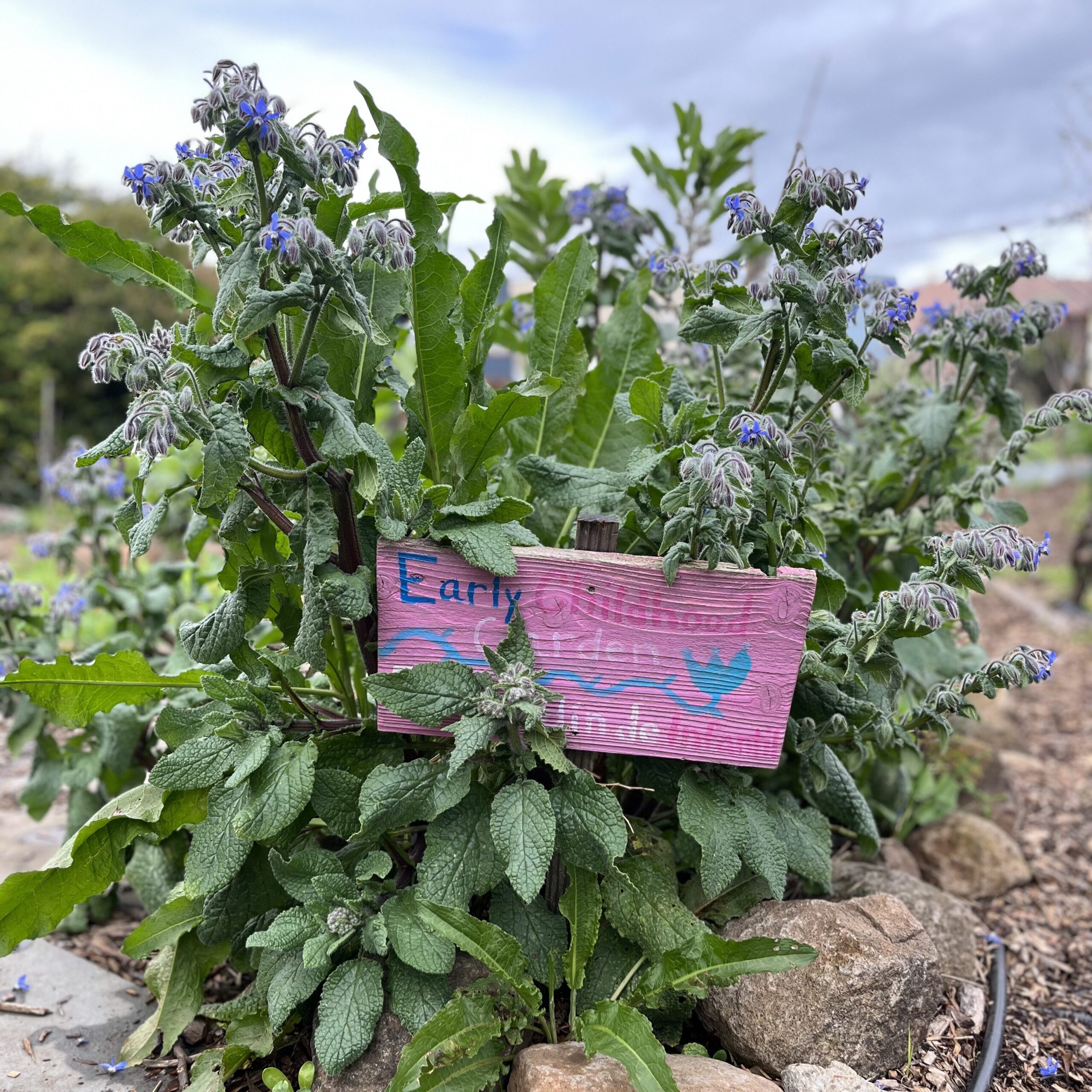
I offered the first grief workshop in that garden in the company of nasturtium, lavender, lemon verbena, rosemary, and California sagebrush. One flower in particular, borage (Borago officinalis), called me in.
I learned from borage that we don’t just give flowers as symbols of beauty in times of grief and sadness to remind us that there is beauty, hope, and good in the world. But we give flowers because the flowers themselves are healers. The flowers we notice–by sight, smell, or proximity–are often the medicine we need to ground and reconnect.
I offered these circles of invitations into conversations about grief like offerings of flowers to educators. I offered a space–not as an expert, but as a fellow educator–to say “yes” to grief’s invitation to be present, to listen, to learn in a community of other educators.
What I know to be true in this moment as I write this reflection is that there is still some part of my grieving process that I don’t know how to make space for, that I still don’t know how to heal from, but I yearn to find a way. And I continue to hold these questions about how we grieve and teach at the same time with you, my fellow educators.
Postscript
In the days after the election, I offered a space to BIPOC educators to share collective grief and collective care in affinity. I needed it and I knew others would, too. We gathered in the same early childhood garden–with the flowers, herbs, vegetable beds and California native plants–where I had offered the first workshop last spring, though this time in the waning light of the golden hour with a fall chill in the air. I am holding onto one bud from that conversation and it is this: in the embodied experience of finding each other in this moment, we will also continue to find our way through grief towards our collective liberation.
About the Author
Roberta Marguerite Chávez (she/her) received a BA and MA in History from Stanford University, a graduate-level Certificate in Somatics from Saint Mary’s College of California, and a teaching certificate from Sacramento Waldorf School. She has danced and performed locally and in far-away places across oceans, taught in liberal arts colleges and universities, and formerly served as Faculty Chair at Golden Bridges School in San Francisco, CA. She is passionate about exploring the relationship between our individual and collective freedom. Roberta was a 2023-2024 SCRR Leadership Fellow.
